Your team relies on a model set to retire in 90 days, but no one can establish which of your services are calling it.
It turns out that there are three, each with its own client library, secrets, and retry logic.
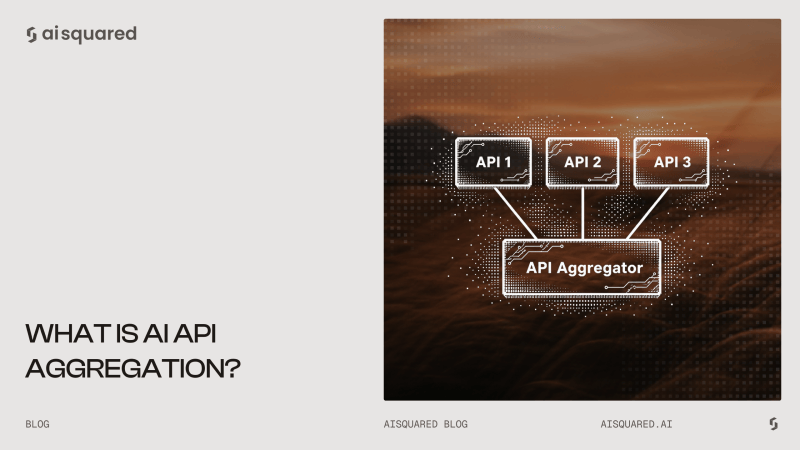
AI API aggregation fixes this by creating a single abstraction for your applications, normalizing requests to your model providers, holding their credentials, routing each request, and logging the results.
What is AI API Aggregation?
AI API aggregation introduces an abstraction layer between applications and AI model providers. The applications send each request to the abstraction layer, which communicates with the providers. Some examples of these elements are:
Applications: Services, agents, and workflows that need a model response.
Aggregation layer: One interface, central credentials, routing, policy, and logging.
Providers: Hosted model APIs, cloud model platforms, and models you host yourself.
In UNIFI, the provider tier consists of OpenAI, Anthropic, Google Vertex AI, Databricks, custom models on AWS Bedrock, and open-source LLMs (large language models). Applications are integrated once and get access to all providers.
What an LLM aggregator does
The LLM aggregator:
Normalizes requests: It adapts one common representation to each provider’s format and vice versa.
Stores credentials: It stores the provider keys at the layer, not in the application code.
Selects providers: The layer chooses which model to call for a request; it can also have a fallback if the first model selection fails.
Tracks usage: It records information about each call, such as the caller, model, tokens processed, latency, and cost.
The LLM aggregator does not make models interchangeable. The models that accept the same request format have different quality of output, reliability of tool-calling capabilities, and context window. The layer only standardizes the information exchange between the application and the LLMs, not their behavior.
Why Multi-Provider Integration becomes Taxing
You could consider the cost of running providers as a kind of fragmentation tax. It includes integration maintenance, security review, and operational complexity that often goes beyond the licensing fees.
This comes from six places:
- Tool-call schemas. One provider returns tool arguments as a JSON string, but another does so as structured objects. Code written to parse one format usually can’t handle others. Every agent needs provider-specific handling for each tool call.
- Streaming formats. Each provider streams responses as differently shaped events. Some send tool-call arguments in fragments to stitch together before parsing. Token usage shows up in different places, sometimes only on request. A streaming client built for one kind breaks on another.
- Token counting. Each model splits text into tokens differently. So, the same prompt gets a different token count, depending on the model. Cost estimates, context-window checks, and truncation logic correct for one provider’s count are wrong for the next.
- Rate limits and errors. Providers cap usage in different units (requests per minute, input tokens per minute, output tokens per minute). They also signal limits through different headers, and disagree on which errors are safe to retry. A retry policy tuned for one model can be too aggressive or too lax on another.
- Deprecation schedules. Each provider retires models on its own schedule. With three providers, you have to track three calendars. An update to any one of them can force an unplanned change across every service that uses the model.
- Scattered keys and spend. Keys exist in environment files and secret stores across services. Rotating one requires you to find every copy. Now when invoices from provider show up with no breakdown by team or use case, nobody can say what a specific feature costs.
Each new provider adds work. Three providers across five services equals fifteen integrations. When an output is wrong across that sprawl, no one can say which model, prompt, or policy produced it.
That is the definition of an accountability gap.
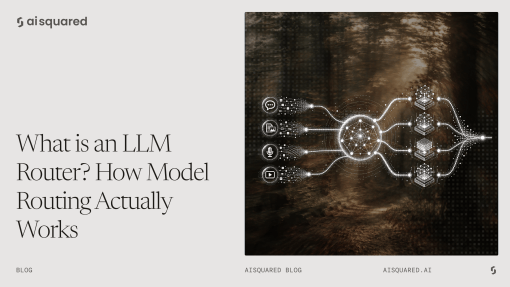
AI API Aggregator vs. Unified AI API vs. AI Gateway vs. LLM Router
| Term | What it is | Problem it solves | Where it sits | Who decides routing |
| Unified AI API | One request and response format across providers | Per-provider integration code | The interface applications code against | The caller names the model |
| AI gateway | Policy enforcement point | Access control, rate limits, guardrails, logging | In front of providers, on every call | The caller; the gateway can restrict allowed models |
| LLM router | Decision logic that picks a model | Cost, latency, and quality per task | Between the request and the provider call | The router, from task and policy |
| AI API aggregator | All three combined | Fragmentation across providers | Between applications and providers | The layer, with caller override |
Unified API is the interface. The gateway is the policy plane. The router is the decision logic. The aggregator is the combined layer.
Judge a product by its functions. Forget labels.
Ask these questions: Does it normalize tool calls and streaming? Enforce policy and log every request? Choose the model? Fail over when a provider degrades?
How AI API Aggregation Works
AI API Aggregation collates everything into one request, traced end to end:
Common schema. The application sends a single request in a standard format to one endpoint.
Authentication and policy. The aggregation layer verifies the caller and checks RBAC (role-based access control, which governs who can use which AI tools and data). It applies PII (personally identifiable information) detection and masking, content policy checks, jailbreak defense, and custom compliance rules.
Routing decision. The router selects a model that aligns with the task type, cost, and latency.
Provider translation. The layer rewrites the request into the chosen provider’s native format and adds that provider’s API key, which the application never deals with.
Retry and fallback. If the endpoint degrades, the layer fails over to a backup model under controlled conditions.
Normalized response and logging. The response returns in the common format. The aggregation layer records timestamps, tokens, latency, caller, and cost.
In UNIFI, Bolt is the default routing layer, and Bolt Instruct is the routing engine.
It sends general tasks such as document RAG (retrieval-augmented generation to connect answers in your own enterprise data), SQL agents. It also sends general chat to smaller models and complex coding tasks to frontier models. Read how the Bolt model family works.
Key Benefits
You see the benefits from different sides. Provider changes land in one adapter instead of every service, and failover rules live in the layer. So a degraded endpoint or a retired model needs no deploy anywhere.
Swapping the model behind a workload becomes a configuration change. Run your eval set first so the swap is measured.
Then there’s the governance side. UNIFI tracks token spend, request volumes, and usage metadata by workspace, team, user role, and task type. Now finance sees cost per team instead of one invoice per provider.
All keys exist in one place. Audit logs record every API request, configuration update, role change, and data access event, with timestamps and IP addresses. When an output is wrong, you can look up which model, caller, and policy were involved.
Consumer Aggregators vs. Enterprise Aggregation Layers
Consumer aggregators are subscriptions. They consist of one account, a menu of models, and a chat window. They save an individual the cost of multiple tools. But for organizations, they offer no control over where prompts are sent, who uses which model, or what gets stored.
Enterprise layers are infrastructure that applications call over an API, so they evaluate them differently. You ask:
Can it be deployed in your VPC (virtual private cloud, an isolated network within your cloud account), on-prem, or in a restricted environment?;
Where do prompts and outputs traverse, and what is stored?;
Are every request logged and exportable?;
Can access be scoped and usage metered per team?;
Does it integrate with the systems your teams already use?;
UNIFI supports VPC and on-prem deployment. We’ve built it to operate in environments where AI error has immediate cost.
How to Implement AI API Aggregation
- Inventory providers and owners: make a list of every provider, every model they’re hosting, every key, and who owns the keys (even those not officially sanctioned).
- Choose a common schema: decide on a format for requests/responses and which capabilities you’ll support (chat, tool calling, embeddings). Keep a way to pass parameters specific to a provider.
- Migrate one low-risk workload: pick a service within your org that’s using a small amount of traffic. Run it through the layer alongside the direct integration and see how it does.
- Add routing/fallbacks: route task types to a model tier. Have a fallback for each primary one, and test them by intentionally failing the primary.
- Add logging + cost attribution: tag every call with a team/workspace/task type before migrating other services.
- Build an eval set: collect input/output examples for each type of workload. Run it pre-deploy on any model changes.
- Retest prompts per model: normalized transport != normalized behavior. A prompt that’s been tuned on one model may show completely different results (structure, length, tool-calling behavior) on another, including your fallback.
Build vs. Buy: Should You Build Your Own Aggregator?
Build your own aggregator if you have one or two providers, a single team consumes them, no audit evidence needed, and unrestricted deployment. A thin in-house or open-source proxy will suffice.
However, costs balloon from here: paying for ongoing adapter maintenance as providers evolve and retire models; on-call support for a system that sits in the call path of every LLM request; guardrails for PII masking and jailbreak protection; the eval sets that let you make changes to the model with confidence; and per-team access controls that generate audit evidence for compliance reviews.
Four factors will help you decide:
provider count (three or more suggests buying), number of teams that will be consuming, whether you have regulated or federal data, and who will own the layer in year two.
UNIFI offers aggregation and the governance layer around it (failover, per-team cost tracking, audit logging, and guardrails) in one solution built on the AI Controls Framework. If your answers to the four questions above lean towards buying, that’s exactly what UNIFI is for.
Limitations And Trade-offs To Plan For
Here are some limitations and trade-offs to be aware of when using an intermediary layer:
Added hop. An intermediary adds a hop between the application and the model. In UNIFI, the choice of model for a given request is made by Bolt, adding approximately 150 milliseconds of latency.
On complex coding tasks, which often use frontier models that take longer to answer, this added latency was about 3% of total latency in AISquared’s internal evaluation.
On general-purpose tasks (document RAG, SQL agent, general chat), the reduction in latency from sending the request to a smaller model outweighed the cost of the routing step.
Queries were 65-71% faster on average, and overall response time decreased from 3.15 seconds to 1.81 seconds (down 42%).
The other limitations have to do with control. A generic interface might obscure provider-specific functionality, so make sure that any necessary provider-specific parameters can be provided, or that the model can be called directly.
The intermediary layer also introduces a single point of failure, since all model calls must go through it; consider deploying it with redundancy.
Providers occasionally change a model’s behavior without changing the name, so pin down specific versions of a model if the provider has versioning available. Run your evaluation set on a recurring schedule to detect such updates before they cause issues in production.
The limitation we would most like to highlight is prompt portability: a prompt that has been tuned for one model might perform unexpectedly on another, giving different results in terms of content, length, or tone.
Fallbacks will generally continue to function, but the quality of the results from the new model may be lower than expected. This issue is not likely to cause an observable error, so it may go unnoticed. Run your evaluation set on all fallback models in advance of any outages.
What To Do Next
With AI API aggregation, switching models is simply changing a variable rather than a code change. Every call is logged.
Start with these steps:
- Inventory every model, key, and owner this week. The gaps are your business case for implementing a shared layer.
- Aggregation covers three of seven layers in the AI Controls Framework. Map your stack against all seven before picking a tool.
- Running three or more providers under audit or deployment constraints? See how UNIFI handles aggregation and governance in one platform.
Frequently Asked Questions
Does the API aggregation prevent access to provider-specific features?
It shouldn’t, but normalization can cause features unique to a provider to become inaccessible. A good layer should allow passing provider-specific parameters or choosing a model outright. New features for a provider typically become available in the aggregation layer after the provider’s API. Test any new features before relying on them.
Does an aggregation layer add significant latency?
It does add some, but in practice it is generally acceptable. In UNIFI, the Bolt routing adds approximately 150 milliseconds to a request, or about 3% to a complex coding task routed to a frontier model. On more common tasks, routing to smaller models reduced latencies by 65-71% and decreased the weighted average latency from 3.15 to 1.81 seconds in AISquared’s testing.
Is an AI gateway the same thing as an aggregator?
Not really; a gateway is primarily focused on policy enforcement (authentication/authorization, rate limiting, guardrails, logging). An aggregator emphasizes model selection and routing, as well as providing a consistent interface to the models it supports. An aggregator usually includes a gateway, but it is a part of the larger system.
When is a single provider sufficient?
A single provider is enough if you have a model that meets your quality requirements, the data is low sensitivity, it is used by a single team, and that team can accept the possibility of an outage from their provider. Any other scenario (a second provider, a second team, or a compliance requirement) needs a whole different approach.